
A founder's documented build
What My Business Website Actually Cost Me to Build
Most website-cost articles give ranges. I can show receipts. I documented the money, time, tools, wrong turns and decisions behind building RebeccaScarberry.com in 37 days.
These are my actual documented costs and experience. They are not a claim about what every small-business website should cost.
The short answer
My documented out-of-pocket build cost was approximately $477.
That number belongs to one specific build: my website, my choices, my 37-day timeline and the tools I used. It is not an industry average or a promise that another founder can reproduce the same result for the same amount.
The total also does not tell the whole story. I invested approximately 180 focused build hours, plus additional stop-and-start time. The dollar cost was only one part of what it took to ship the site.
The documented numbers
What was in the build record
These headline figures capture the recurring, one-time and variable costs I documented. The $55.80 figure is the monthly run rate at the end of the build, not a one-time line item to add directly to every other number.
$55.80
Monthly recurring costs
The approximate monthly website and business-system run rate at the end of the documented build.
$100
One-time Lovable credits
The documented one-time credits purchased during the build.
$10
Annual domain cost
The documented annual cost for the domain.
$297
Variable AI research costs
The approximate documented cost of AI-supported research during the project.
Because recurring costs, annual costs, project purchases and variable research usage cover different periods, the category snapshots are not intended as a simple addition problem. The complete documented record totals approximately $477 out of pocket.
Time was a real cost
How long did it take me to build the website?
37 days, approximately 180 focused build hours, and more time around the edges.
The documented build ran for 37 days. Within that period, I logged approximately 180 focused hours of building. There was also additional stop-and-start time that does not fit neatly into an hours column.
I was learning systems, comparing options, revisiting decisions and recovering from lost work while still operating as a founder. Decision fatigue was part of the project. So was the mental cost of figuring out what the site needed to say and what it did not need.
A low cash total can hide a large labor investment. My record makes both visible because a realistic website-cost answer has to account for time as well as money.
- Researching seven platforms before committing
- Trying two platforms in real working conditions
- Learning unfamiliar systems while making business decisions
- Managing decision fatigue across content, structure and tools
- Recovering from work that was lost along the way
- Working in focused blocks plus additional stop-and-start time
The platform decision
Research seven, try two, ship one.
I researched seven platforms. Research helped me understand the field, but it could not tell me what working inside a platform would actually feel like. I tried two and shipped one.
My first attempt was in Squarespace. I then pivoted to Lovable. That pivot was not a generic verdict on which platform is best. It was a founder making a practical decision after testing what worked for this particular site, this working style and this set of priorities.
The lesson was not to keep comparing forever. Research enough to make an informed start, test the strongest candidates with real work, then commit to the one that lets you finish.
Ownership
“If the platform holds it and I can't retrieve it, it isn't mine yet.”
Building a site is not only about getting pages online. It is also about understanding what you control, what you can export, what you can recover and what happens to your work when something goes wrong.
Lost work made that lesson concrete for me. A tool can make building feel easy while still leaving important questions about access and retrieval unanswered. I learned to treat recoverability as part of ownership, not as an afterthought.
Defensible choices
“Every choice on this site is one I can defend out loud.”
A founder website contains hundreds of choices: what belongs on the first page, what gets cut, which proof matters, what a visitor should do next and which tools are worth paying for.
I did not need every decision to be permanent or perfect. I needed each one to have a reason. That standard helped turn a long list of possibilities into a site I could actually ship.
My experience as a founder and operator shaped those calls. You can read more about that background on my About page.
What the number can and cannot tell you
A documented cost is useful because it has context.
What my record shows
What I paid, how long I worked, which path I tested, where I changed direction and what it took to finish this specific website.
What it does not claim
That every owner should use my tools, follow my timeline, spend the same amount or expect the same build experience.
The useful question is not whether $477 is the right price for a small-business website. It is what was included in that number, what was paid in time, and which decisions made shipping possible.
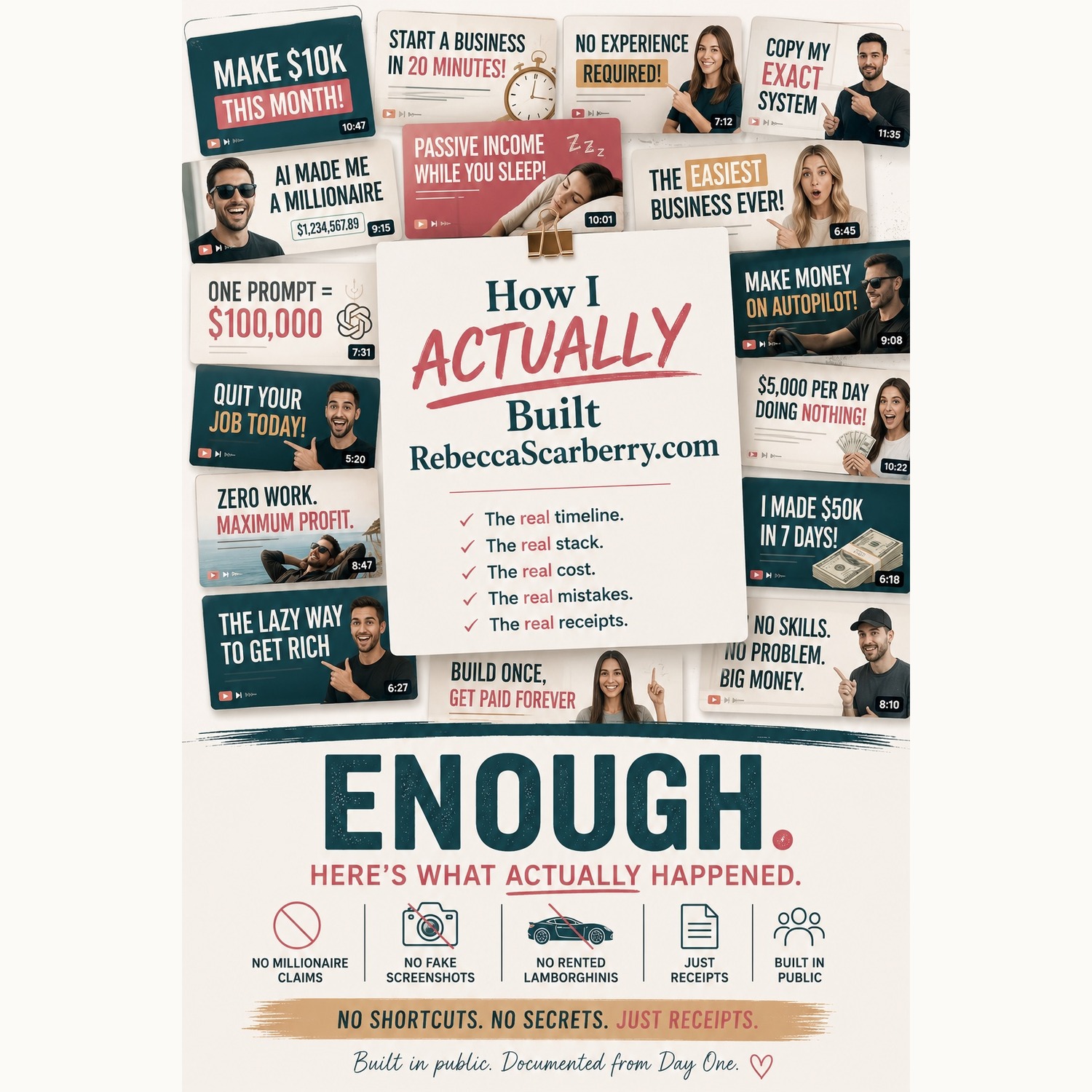
The complete founder build record
How I Built RebeccaScarberry.com
$97
This page gives you the real headline costs, timeline and lessons. The book contains the complete founder build record: the process, decisions, mistakes, tools and receipts documented from the work itself.